
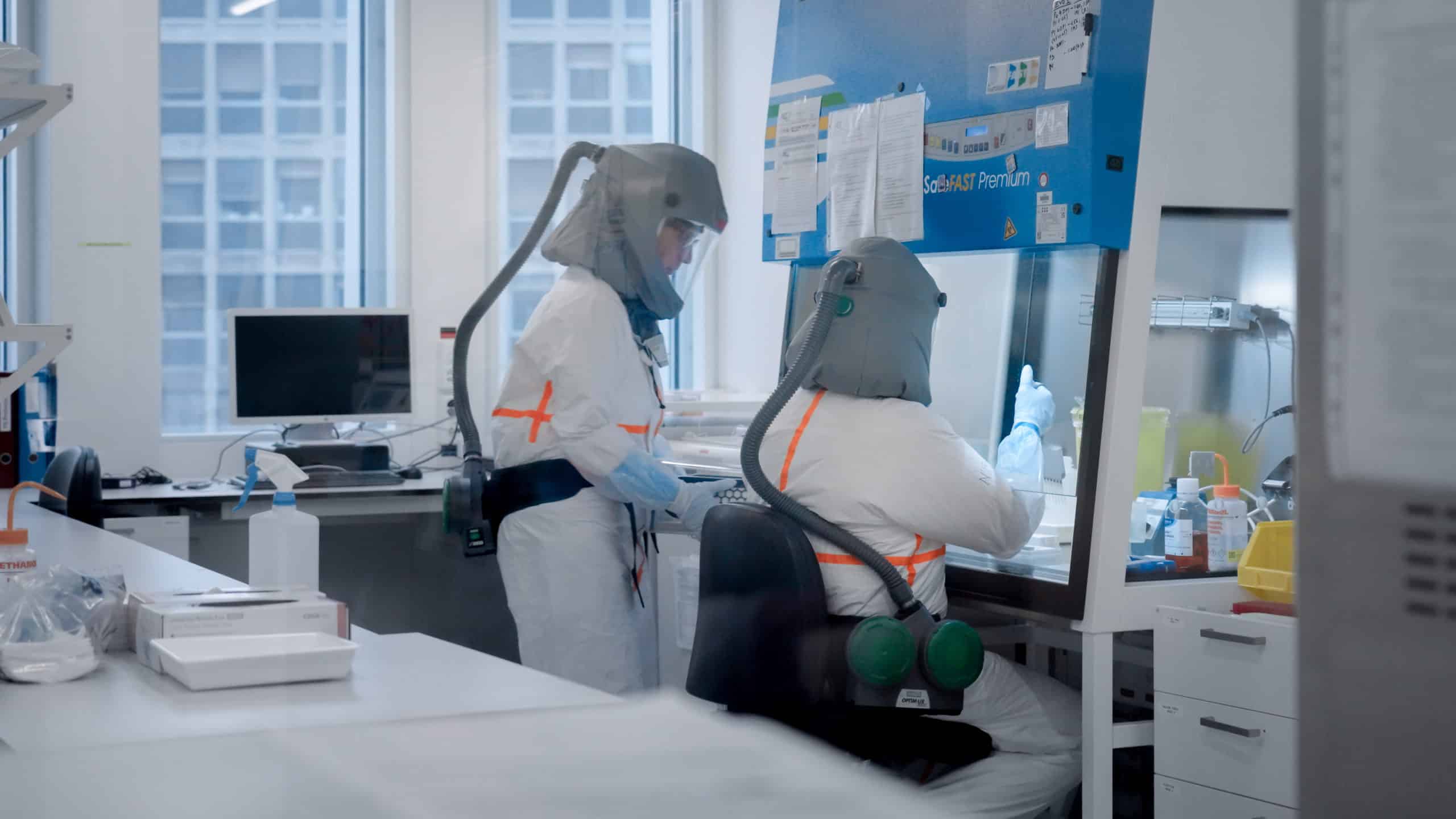
Réalisation du film par Noxediem
Chaque année, l’hépatite E infecte plus de 20 millions de personnes dans le monde. Elle provoque au moins 44 000 décès, concentrés en Afrique et en Asie, où circule le génotype 1 (HEV-1), responsable de vastes épidémies liées à l’eau contaminée. Chez les femmes enceintes, la mortalité peut atteindre 25% dans certaines de ces régions touchées par l’insuffisance de l’assainissement et des infrastructures sanitaires fragiles. Malgré cet impact considérable, ce virus demeure largement sous-étudié et sous-diagnostiqué. Les outils pour le combattre restent limités, notamment en raison de sa grande stabilité dans l’environnement.
« L’hépatite E est l’une des maladies les plus difficiles à gérer sur le terrain et, en situation d’épidémie, très peu de solutions concrètes existent », déplore la Prof. Isabella Eckerle, directrice du Centre des maladies virales émergentes des Hôpitaux universitaires de Genève (HUG) et professeure à la Faculté de médecine de l’Université de Genève (UNIGE). Cette spécialiste des maladies virales émergentes vise à combler cette lacune grâce à une recherche distinguée par l’un des deux Prix scientifiques Leenaards 2026.
« L’espoir de notre groupe de recherche est d’identifier rapidement des candidats antiviraux afin de disposer, en cas d’épidémie, d’un traitement capable d’aider les personnes atteintes de formes sévères de la maladie », souligne Isabella Eckerle. La professeure mène ce projet aux côtés du Prof. Jérôme Gouttenoire (FBM-UNIL), chef de laboratoire au Service de gastro-entérologie et d’hépatologie du CHUV, où sont conduits des travaux de recherche fondamentale sur l’hépatite E, et de l’épidémiologiste Dr Andrew Azman (HUG / UNIGE), qui travaille notamment en étroite collaboration avec Médecins Sans Frontières Suisse (MSF) et au sein du Centre des maladies virales émergentes des HUG – UNIGE.

Collection unique d’échantillons provenant d’une récente épidémie, constituée avec l’aide de MSF
En 2022, lors d’une flambée épidémique majeure d’hépatite E au Soudan du Sud, MSF et le ministère de la Santé du pays ont mené une campagne de vaccination d’urgence. Comme il s’agissait de la première utilisation du vaccin dans un contexte de santé publique en Afrique, MSF a également lancé une étude de recherche afin d’en évaluer l’efficacité dans cette population. Dans le cadre de ce travail, des milliers d’échantillons sanguins ont été prélevés auprès de personnes infectées et de personnes vaccinées. À partir des échantillons restants de cette étude, l’équipe de recherche du laboratoire du Prof. Jérôme Gouttenoire (CHUV-UNIL) a réalisé une avancée majeure en reconstituant une version infectieuse du virus HEV-1 in vitro. « Nous sommes parvenus à introduire le matériel génétique du virus dans des cellules humaines afin de pouvoir le cultiver en laboratoire. Cela n’avait encore jamais été réalisé pour ce génotype après reconstitution du génome viral », explique Jérôme Gouttenoire. Cette avancée ouvre des perspectives prometteuses : elle permet désormais d’analyser précisément la réponse immunitaire après infection ou vaccination, d’évaluer l’efficacité des anticorps produits et de tester, à grande échelle, des molécules susceptibles d’empêcher la réplication du virus.
En reliant ainsi directement les données issues d’une épidémie récente à des travaux de recherche fondamentale, ce projet de recherche incarne une approche résolument translationnelle. « À terme, notre projet pourrait renforcer la préparation mondiale face aux flambées épidémiques d’hépatite E et contribuer à réduire l’impact d’un virus encore largement négligé par les acteurs de la santé publique et la recherche internationale », conclut l’épidémiologiste Andrew Azman (HUG / UNIGE).
Decoding the hepatitis E virus to counter epidemics
The research groups, led by Prof. Isabella Eckerle, a clinical virologist at Geneva University Hospitals (HUG) and the University of Geneva (UNIGE), is developing an effective treatment for hepatitis E that can prevent the genotype 1 virus from replicating and spreading during an epidemic. Hepatitis E causes the death of at least 44,000 people in Africa and Asia every year, including pregnant women, yet relatively few studies have been conducted on the virus.
Film produced by Noxediem
Over 20 million people around the world are infected with hepatitis E every year, leading to at least 44,000 deaths – primarily in Africa and Asia where the genotype 1 virus (HEV-1) spreads through contaminated drinking water, triggering vast epidemics. The mortality rate among pregnant women can reach 25% in regions with poor water-purification and sanitation infrastructure. Despite this heavy toll, relatively little research has been performed on HEV-1, and hepatitis E is still largely under-diagnosed. What’s more, the virus is highly stable in the environment, meaning doctors have few tools for combating it.
“Hepatitis E is one of the hardest diseases to deal with out in the field. Very few actionable solutions are available when an epidemic strikes,” says Prof. Eckerle, head of the Centre for Emerging Viral Diseases at HUG and a professor at the University of Geneva (UNIGE)Faculty of Medicine. She aims to address this problem through one of the two projects selected for the 2026 Leenaards Science Prize.
“Our research group’s hope is to be able to rapidly identify antiviral drug candidates in order to give doctors a treatment they can use during epidemics to help patients with severe forms of the disease,” says Dr. Eckerle a professor at the UNIGE Faculty of Medicine. She is spearheading this project alongside Prof. Jérôme Gouttenoire – a professor at the University of Lausanne (UNIL) Faculty of Biology and Medicine (FBM) and head of the Lausanne University Hospital (CHUV) gastroenterology and hepatology department – whose laboratory is conducting fundamental research on hepatitis E, – and Dr. Andrew Azman, an epidemiologist at the HUG – UNIGE Centre for Emerging Viral Diseases and UNIGE who works closely with Médecins Sans Frontières (MSF) Switzerland.
A unique collection of samples from a recent epidemic, built with the help of MSF
When a major hepatitis E epidemic broke out in South Sudan in 2022, MSF and the South Sudan Ministry of Health conducted an emergency vaccination campaign. Because this was the first public-health use of the vaccine in Africa, MSF also launched a research study to assess how well the vaccine performed in this population. As part of that work, thousands of blood samples were collected from both infected and vaccinated individuals. Using the remaining samples from this study, Prof. Gouttenoire’s research team at the CHUV achieved a major breakthrough: they successfully created an infectious version of HEV-1 in vitro.“We were able to introduce the virus’s genetic material into human cells so that we could cultivate it in a laboratory,” says Prof. Gouttenoire. “That had never been done before with this genotype after the virus’s genome had been replicated.” This breakthrough opens up promising new avenues of research. Scientists will now be able to analyze the exact immune-system response after vaccination or infection with the virus, determine how effective the resulting antibodies are, and run large-scale tests on drugs that could potentially stop the virus from replicating.
This project clearly illustrates the benefits of a translational approach, as it combines fundamental research with data collected during a recent epidemic. “Our project could enable healthcare teams to respond more effectively to hepatitis E outbreaks and reduce the impact of a virus that’s still largely overlooked by the international public health and research communities,” says Dr. Azman.